
Generic Cover Letter Template
Generic Cover Letter Template - Reference addsingleton(iservicecollection, tservice) additionally you can bind the object graph using configurationbinder.get reference configuration in asp.net core : So, my approach was to put all my logic into a generic method with no constraints, but to make that generic method private. This didn't come up in my initial search but here's the answer from jon skeet Meaning that one method can't handle both scenarios. For example, if foo was an interface, you could create the following interface in your test class. But of course it's still not enforced at compile time.
Because under the hood, the compiler will go away and create a new type (sometimes called a closed generic type) for each different usage of the open generic type. You could always create an intermediate class/interface that would satisfy the generic type that you are wanting to specify. I have a generic method that takes a request and provides a response. But of course it's still not enforced at compile time. Meaning that one method can't handle both scenarios.

Generic Cover Letter Format Templates at
But of course it's still not enforced at compile time. Bind to an object graph The point about generic types, is that although you may not know them at coding time, the compiler needs to be able to resolve them at compile time. 0) evaluates to 2 (character constants are ints in c). Because under the hood, the compiler will go away and create a new type (sometimes called a closed generic type) for each different usage of the open generic type.
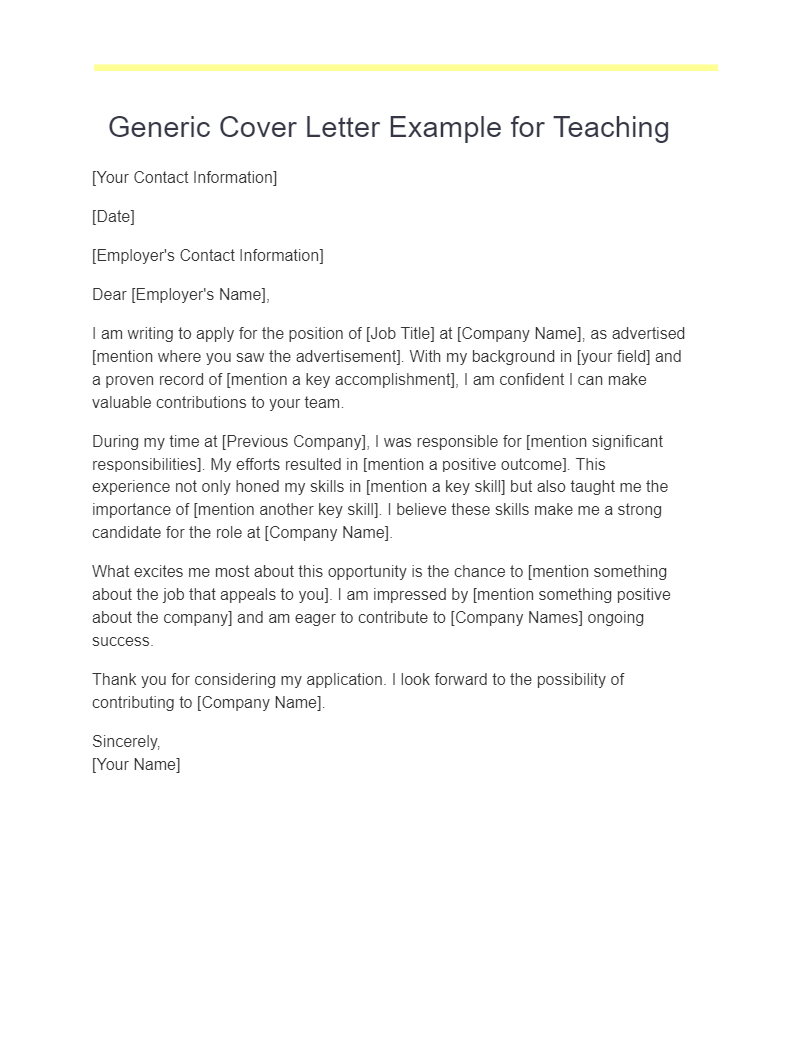
Generic Cover Letter 15+ Examples, How to Use, PDF
Because under the hood, the compiler will go away and create a new type (sometimes called a closed generic type) for each different usage of the open generic type. Reference addsingleton(iservicecollection, tservice) additionally you can bind the object graph using configurationbinder.get reference configuration in asp.net core : I have a generic method that takes a request and provides a response.

301 Moved Permanently
Multiple generic constraints can't be combined in an or fashion (less restrictive), only in an and fashion (more restrictive). The point about generic types, is that although you may not know them at coding time, the compiler needs to be able to resolve them at compile time. The syntax is similar to a simple switch statement for types: So, my approach was to put all my logic into a generic method with no constraints, but to make that generic method private.

Generic Cover Letter Template
The generic constraints also cannot be used to make a unique signature for the method, so you'd have to use 2 separate method names. This didn't come up in my initial search but here's the answer from jon skeet Class in order to satisfy the constraint of the addsingleton call. As stated in the comments you should set the generic constraint to where t: But of course it's still not enforced at compile time.

Generic Cover Letter Template
You could always create an intermediate class/interface that would satisfy the generic type that you are wanting to specify. This didn't come up in my initial search but here's the answer from jon skeet I have a generic method that takes a request and provides a response. For example, if foo was an interface, you could create the following interface in your test class.
Generic Cover Letter Template - But of course it's still not enforced at compile time. The generic constraints also cannot be used to make a unique signature for the method, so you'd have to use 2 separate method names. Multiple generic constraints can't be combined in an or fashion (less restrictive), only in an and fashion (more restrictive). So, my approach was to put all my logic into a generic method with no constraints, but to make that generic method private. Public tres dosomething<tres, treq>(tres response, treq request) {/*stuff*/} but i don't always want a response for my request, and i don't always want to feed request data to get a response. The syntax is similar to a simple switch statement for types:
Multiple generic constraints can't be combined in an or fashion (less restrictive), only in an and fashion (more restrictive). For example, if foo was an interface, you could create the following interface in your test class. I'm not quite sure how to do that, but what i would like to do is to create a special type of property that will perform specific tasks at the get and set, and will be defined on generic type. As stated in the comments you should set the generic constraint to where t: Private interface foobar extends foo { }
I'm Not Quite Sure How To Do That,
Meaning that one method can't handle both scenarios. But of course it's still not enforced at compile time. Generic selection is implemented with a new keyword: As stated in the comments you should set the generic constraint to where t:
The Point About Generic Types, Is That Although You
This didn't come up in my initial search but here's the answer from jon skeet I only return from a stream because after using the resize code similar to this the destination file has an unknown mime type (img.rawformat.guid) and id like the mime type to be correct on all image objects as it makes it hard write generic handling code otherwise. Because under the hood, the compiler will go away and create a new type (sometimes called a closed generic type) for each different usage of the open generic type. Reference addsingleton(iservicecollection, tservice) additionally you can bind the object graph using configurationbinder.get reference configuration in asp.net core :
This At Least Guarantees That The Type
Public tres dosomething<tres, treq>(tres response, treq request) {/*stuff*/} but i don't always want a response for my request, and i don't always want to feed request data to get a response. The syntax is similar to a simple switch statement for types: I have a generic method that takes a request and provides a response. Multiple generic constraints can't be combined in an or fashion (less restrictive), only in an and fashion (more restrictive).
0) Evaluates To 2 (Character Constants Are Ints
The generic constraints also cannot be used to make a unique signature for the method, so you'd have to use 2 separate method names. @mcgarnagle a generic method (such as an extension method) can use a generic helper class to apply this pattern. So, my approach was to put all my logic into a generic method with no constraints, but to make that generic method private. Private interface foobar extends foo { }